Soft close
or push to open?
They solve different problems and they interact, which is why a handleless kitchen has to decide between them or pay for the mechanism that does both.
The short answer
Soft close slows a door or drawer over the last few centimetres so it cannot slam. Push to open releases a catch when you press the front, so no handle is needed. The complication is that they work against each other: a push-to-open catch needs to spring the front outward, and a soft-close damper is resisting movement at exactly that point. Combining them needs a mechanism built for it, which exists and costs more. Blum and the other quality brands make it; the cheap end does not.
What each is for
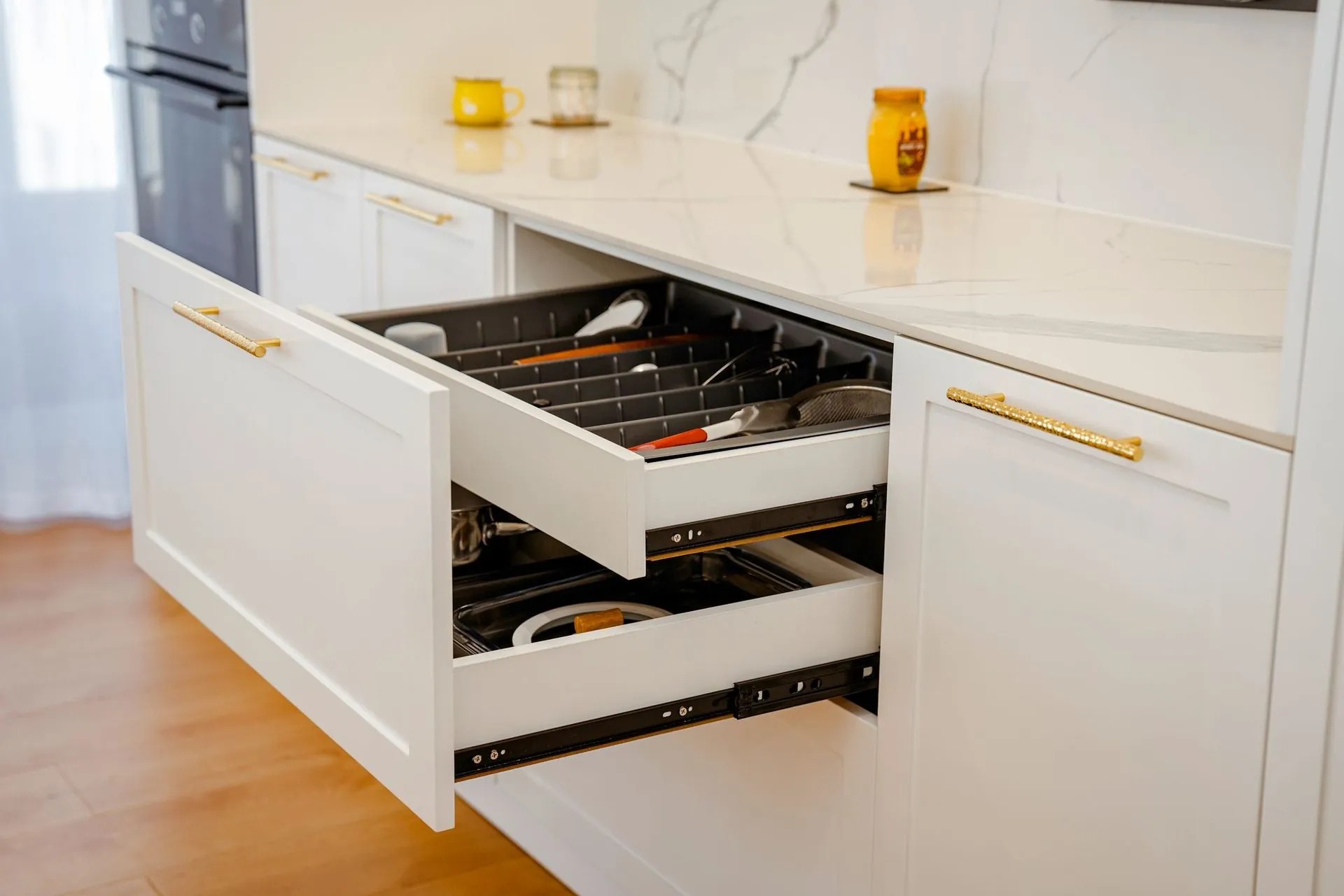
Soft close is about longevity and noise. A drawer slammed daily for ten years loosens its joints and its runners; a damper removes that entirely, and it is why we fit it as standard. Push to open is about appearance @EM@ it lets a kitchen have no handles at all, without a shadowline or a J-pull.
Why they conflict
Push to open works by holding the front under slight tension and releasing it when pressed. Soft close resists movement at the end of travel. Put a basic version of each on the same drawer and the drawer either will not spring open or will not close softly. The combined mechanisms are engineered to sequence the two, which is why they are a separate, dearer product line.
Which to choose
If you want handles or a shadowline, take soft close everywhere and be done. If you want a completely handle-free kitchen, decide whether the extra cost of combined mechanisms is worth it, or accept push to open without damping on those fronts. Our push-to-open guide and soft-close guide cover each on its own.
What we fit as standard
Soft close on every hinge and every drawer runner, from Blum, at no extra line on the quote. Push to open is quoted per cabinet where you want it, and we will tell you which mechanism combines the two and what it costs before you decide.
Sizes, hardware and services
More in this series: Standard cabinet sizes · Bench height · Hinge overlay · Benchtop thickness · Drawers vs cupboards · Appliance cut-outs · Undermount vs topmount · Under-cabinet lighting · Runner load ratings · The work triangle · Power point placement.
Frequently asked
Common questions
If your question is not here, call the studio. We would rather talk it through than have you guess.
Ask us directly →Can you have soft close and push to open together?
Yes, but it needs a mechanism designed for it, which costs more. Basic versions of each fight one another on the same drawer.
Is push to open reliable?
Quality mechanisms are. The failures people describe usually come from cheap catches that lose tension, or from combining them with damping that was not designed to work together.
Do I need push to open for a handleless kitchen?
No. A shadowline or a handle rail gives the same handle-free look while keeping ordinary soft-close hardware.
Is soft close standard?
On our cabinetry, yes, on every hinge and runner. It is not standard across the industry, which is worth asking any supplier directly.
Delivered assembled
The assembly is done
before it arrives.
Carcasses built square on a bench, Blum hardware fitted, doors hung and adjusted to even gaps. On site you are fixing finished cabinets to a wall, not building them on the floor. Our own team fits it in Central Queensland; your installer fits it anywhere else in Australia. Prefer to build it yourself? The same kitchen ships flat pack.
Black joinery, marble bar
Kitchen into dining, one palette
Full-height joinery, fitted in days
Specification
The same three answers,
on every quote.
Board thickness and moisture rating, edging method, hardware brand. Ours are printed on the quote so you can hold them against anything else you are offered.