Undermount
or topmount sink?
The decision is usually made by your benchtop material rather than by preference, and it changes how the bench cleans more than how it looks.
The short answer
A topmount or drop-in sink sits on top of the benchtop with its rim visible. An undermount is fixed beneath, so the benchtop edge forms the opening and you can sweep straight into the bowl. Undermount needs a benchtop that can take a sealed, finished cut-out @EM@ stone, porcelain or solid surface. Most laminate tops cannot, because the exposed core would take on water, so laminate usually means topmount.
What changes day to day
With an undermount there is no rim on the bench, so crumbs and water go straight in and the whole surface wipes in one movement. With a topmount the rim sits proud and the seal around it is where grime collects over the years. That is the practical difference, and for most people it is the deciding one.
What your benchtop allows
Stone, engineered stone and porcelain take an undermount, because the cut edge is polished and sealed. Laminate generally does not @EM@ the chipboard core behind the laminate will swell if water reaches it, and a cut-out puts the core right at the wettest point in the kitchen. Some laminate products are rated for undermount; most are not, and the manufacturer decides, not the installer.
Cost and fabrication
An undermount costs more because the cut-out has to be polished and the sink fixed and sealed from below, usually by the stone fabricator rather than the plumber. A topmount drops into a cut-out and clamps from above, which any installer can do. The difference is in labour, not the sink.
Ordering either way
Tell us the sink model before we cut, or the cut-out dimensions from its specification sheet. Undermount sinks are set out by the fabricator when they template the stone, which happens after the cabinets are installed. Our cut-out guide covers why the model matters before anything is made.
Sizes, hardware and services
More in this series: Standard cabinet sizes · Bench height · Hinge overlay · Benchtop thickness · Drawers vs cupboards · Appliance cut-outs · Under-cabinet lighting · Soft close vs push to open · Runner load ratings · The work triangle · Power point placement.
Frequently asked
Common questions
If your question is not here, call the studio. We would rather talk it through than have you guess.
Ask us directly →Is an undermount sink better?
It is easier to clean, because there is no rim on the benchtop. Whether you can have one depends on the benchtop material.
Can you undermount a sink in a laminate benchtop?
Usually not. The chipboard core would be exposed at the wettest point of the kitchen. Some laminate products are rated for it; check with the manufacturer, not the installer.
Does an undermount sink cost more?
Yes, mostly in fabrication. The cut-out has to be polished and the sink fixed and sealed from below by the stone fabricator.
When is the sink cut-out made?
For stone, after the cabinets are installed and the benchtop is templated. For laminate, in the factory, which is why the sink model has to be confirmed before the top is made.
Delivered assembled
The assembly is done
before it arrives.
Carcasses built square on a bench, Blum hardware fitted, doors hung and adjusted to even gaps. On site you are fixing finished cabinets to a wall, not building them on the floor. Our own team fits it in Central Queensland; your installer fits it anywhere else in Australia. Prefer to build it yourself? The same kitchen ships flat pack.
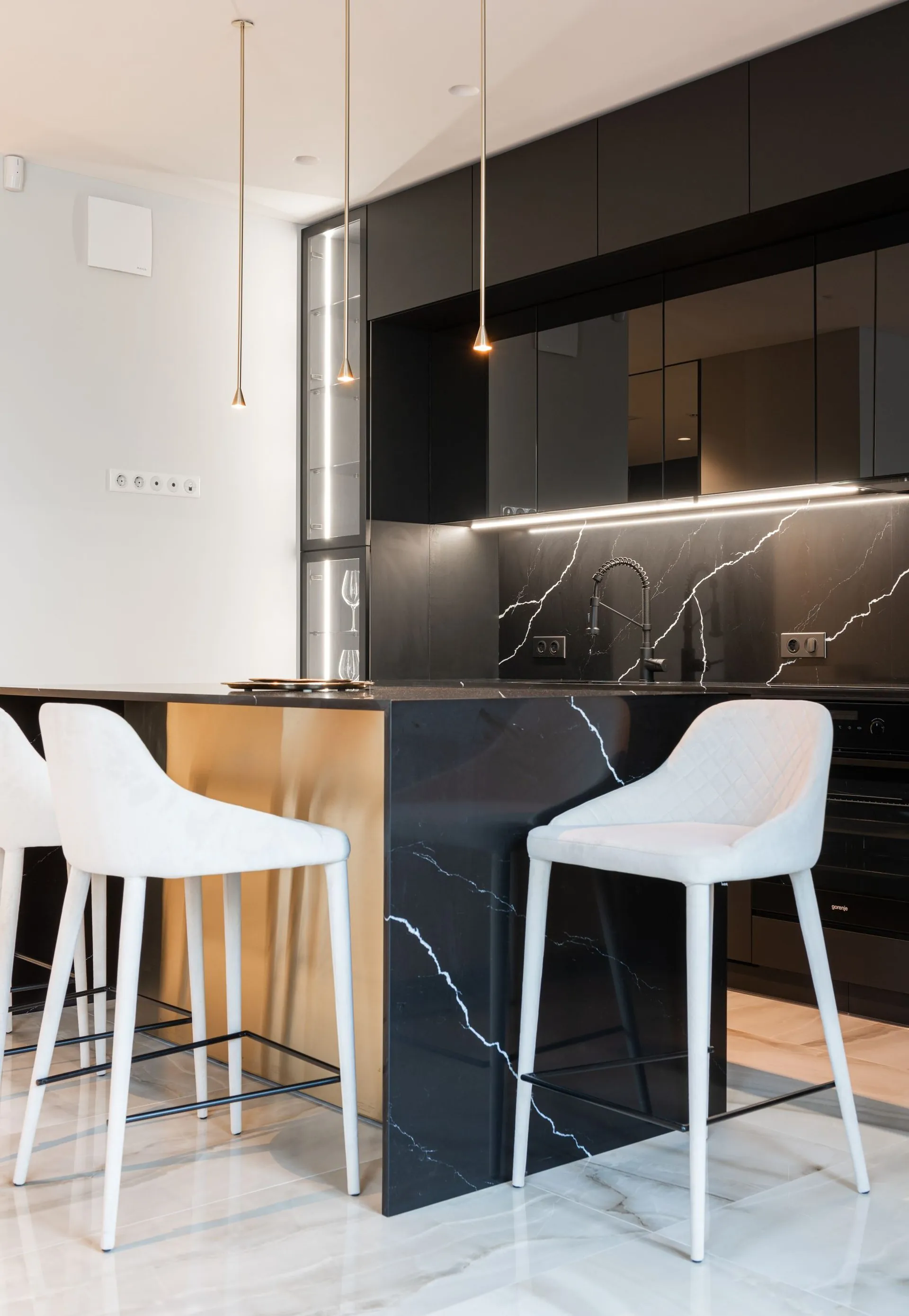
Black joinery, marble bar

Timber island, stone top

Oak run, doors hung and adjusted before delivery

Specification
The same three answers,
on every quote.
Board thickness and moisture rating, edging method, hardware brand. Ours are printed on the quote so you can hold them against anything else you are offered.